Adam
In Genesis, Adam and Eve are the parents of Cain, Abel, and Seth. Their shared row begins this family tree.
Genesis 4:1–2, 25
Official Covenant Cards guide
Command legends, defy empires, and build your own strategy across a fractured timeline. Explore the world, cards, and battles of Covenant Cards.
Drag cards into play and aim attacks in a short, simplified practice encounter inspired by Covenant Cards. Both captains start with 15 health. Each side has at most seven turns, then remaining captain health determines the result. This browser preview is separate from the full native game.
Choose Vanguard for rush and pressure, Sanctuary for guarding and healing, or Serpent for poison and spells. These 16-card preview decks face Assault, Bastion, or Hex opponents. Share an encounter seed to repeat the same opening and draws under the current preview rules. Retry the same challenge or start a new one.
Real gameplay, captured on a phone. Place a card, build your board, and watch an ability change the fight.
A nine-second recording of card placement and a buff effect. Interface and balance may differ by edition and release.
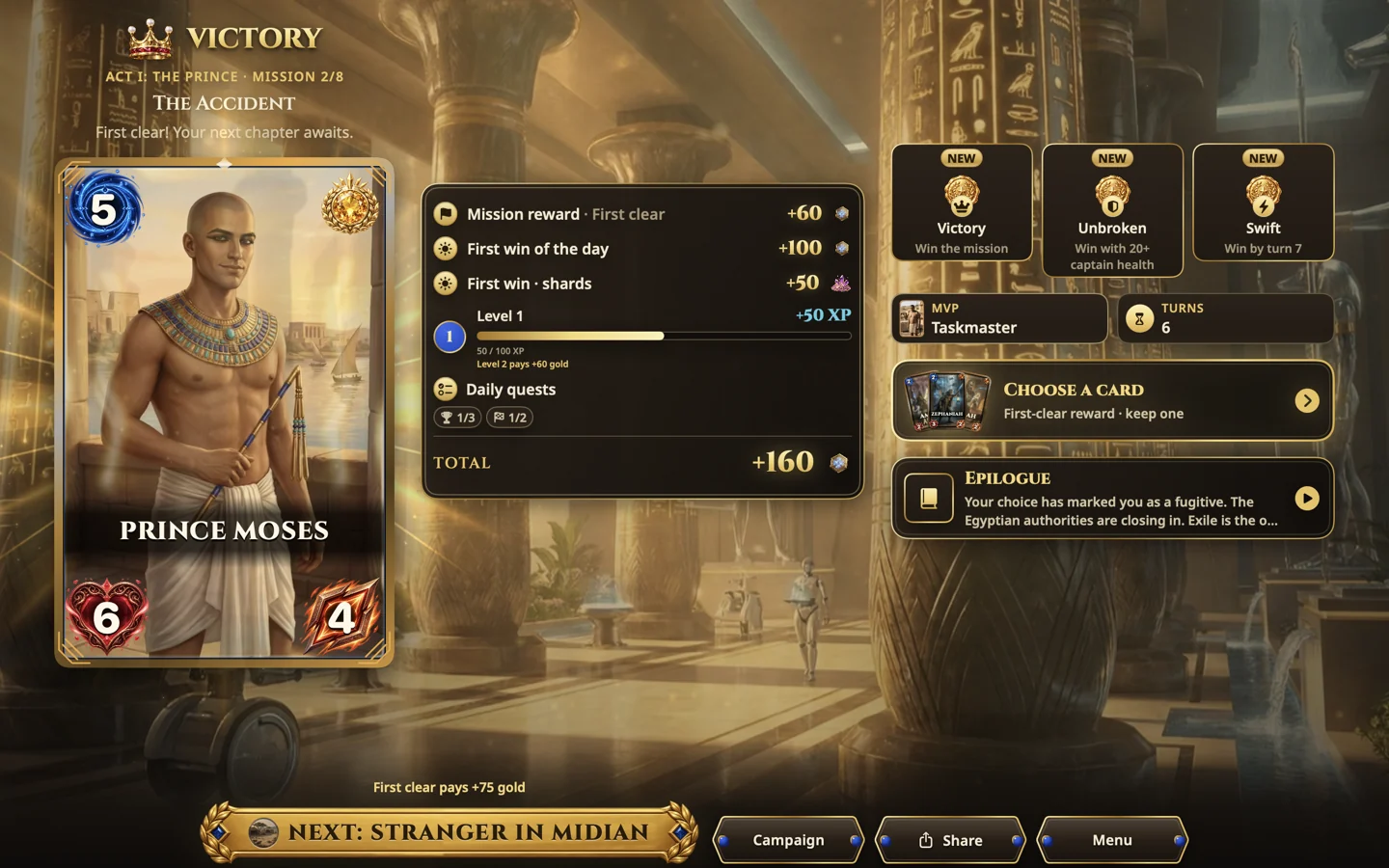
Bring illustrated figures, spells, and artifacts together around a strategy.
Play single-player campaigns offline on either platform. Modes and purchases differ by platform.
Explore lineage, card lore, and the connections across generations.
Open unlimited free packs, with three cards in every pack and 100 browser collectibles across six rarity finishes. Progress is saved in this browser. Browser collectibles do not unlock cards in the full game.
Follow the family branches from Adam and Eve to Noah, Shem, Ham, and Japheth. Select a figure to see their connections.
Adam and Eve begin generation 1. This tree follows selected family lines in Genesis 4–6 and 10 through Noah’s three sons in generation 11. Adah and Zillah appear beside Lamech; their parents are not named.
In Genesis, Adam and Eve are the parents of Cain, Abel, and Seth. Their shared row begins this family tree.
Genesis 4:1–2, 25
Also known as Chavah.
Genesis names Eve as Adam’s wife and the mother of Cain, Abel, and Seth. Her connections lead to all three sons shown here.
Genesis 4:1–2, 25
Also known as Kain.
Cain cultivates the ground in Genesis. He is Abel’s brother and the father of Enoch, whose family line continues through Irad.
Genesis 4:1–2, 17–18
Also known as Hevel.
Abel tends sheep in Genesis. The narrative recounts his death at Cain’s hands; it names no descendants of Abel.
Genesis 4:2–10
Also known as Sheth.
Seth is born to Adam and Eve after Abel’s death. Genesis names him as Enosh’s father and continues his line in chapter 5.
Genesis 4:25–26; 5:3–8
Also known as Enoch son of Cain.
Cain names a city after his son Enoch, the father of Irad. This is not the later Enoch in Seth’s line.
Genesis 4:17–18; 5:18–24
Also known as Enos.
Enosh is the son of Seth and father of Kenan. His name appears as Enos in the King James Version.
Genesis 5:6–11
In Cain’s family line, Irad is the son of Enoch and the father of Mehujael.
Genesis 4:18
Also known as Cainan.
Kenan is Enosh’s son and Mahalalel’s father in the genealogy of Genesis 5. The King James Version calls him Cainan.
Genesis 5:9–14
Mehujael is the son of Irad and father of Methushael in Cain’s line. His family is listed in Genesis 4.
Genesis 4:18
Also known as Mahalaleel.
Mahalalel is Kenan’s son and Jared’s father in Seth’s line. His name appears as Mahalaleel in the King James Version.
Genesis 5:12–17
Also known as Methusael.
Methushael is the son of Mehujael and father of Lamech in Cain’s line. He is distinct from Methuselah in Seth’s line.
Genesis 4:18
Genesis names Jared as Mahalalel’s son and Enoch’s father in Seth’s line. This Enoch is distinct from Cain’s son.
Genesis 5:15–20
Also known as Lamech in Cain’s line.
Lamech is Methushael’s son in Cain’s line. Genesis names Adah and Zillah as his wives and describes the household of Jabal, Jubal, Tubal-cain, and Naamah.
Genesis 4:18–24
Adah is one of Lamech’s wives in Genesis 4. She gives birth to Jabal, and the passage identifies Jubal as his brother. Her ancestry is not provided.
Genesis 4:19–21
Zillah is one of Lamech’s wives and the mother of Tubal-cain. The same passage names Naamah as Tubal-cain’s sister; Zillah’s own ancestry is not provided.
Genesis 4:19, 22
Also known as Enoch son of Jared.
Enoch is Jared’s son and Methuselah’s father in Seth’s line. Genesis describes him as walking with God. He is distinct from Enoch, Cain’s son.
Genesis 5:18–24
Jabal belongs to Lamech and Adah’s household. Genesis associates him with people who dwell in tents and keep livestock.
Genesis 4:19–20
Jubal is Jabal’s brother in the household of Lamech and Adah. Genesis associates him with music and the playing of instruments.
Genesis 4:19–21
Also known as Tubalcain, Tubal Cain.
Tubal-cain is Zillah’s son in Lamech’s household. Genesis associates him with working bronze and iron and names Naamah as his sister.
Genesis 4:19, 22
Genesis names Naamah as Tubal-cain’s sister. She is shown beside him in the household of Lamech and Zillah; this passage gives no further biography.
Genesis 4:19, 22
Methuselah is the son of Enoch and father of Lamech in Seth’s line. He is distinct from the earlier Methushael in Cain’s line.
Genesis 5:21–27
Also known as Lamech in Seth’s line, Lamech father of Noah.
Lamech is Methuselah’s son and Noah’s father in Seth’s line. He is distinct from Lamech in Cain’s line.
Genesis 5:25–29
Noah is Lamech’s son in Seth’s line and the father of Shem, Ham, and Japheth. Genesis tells how he builds the ark before the Flood.
Genesis 5:28–32; 6:9–22
Shem is one of Noah’s three sons, named alongside Ham and Japheth. His family forms one of the branches described after the Flood.
Genesis 5:32; 6:10; 10:1
Ham is Noah’s son and brother of Shem and Japheth. Genesis names him among the fathers of the families described after the Flood.
Genesis 5:32; 6:10; 10:1
Japheth is Noah’s son and brother of Shem and Ham. His family appears alongside theirs in the generations that follow the Flood.
Genesis 5:32; 6:10; 10:1
Relationships follow the Genesis narrative. Portraits combine Covenant Cards artwork and imaginative illustrations. Genesis names Naamah as Tubal-cain’s sister; she appears with Lamech and Zillah’s household as described in Genesis 4:19–22.
Discover the cards, explore their skills, and find strategies for your next battle.
Open the complete field guideExplore Exodus, Kingdoms, Empires, Diaspora, and New horizons in a reimagined history.
Three moments from the game’s origin story: the prince, the awakening, and the crossing.
Egypt · common · 2 mana
Egypt · common · 1 mana
Judaism · common · 1 mana
Judaism · common · 3 mana
Judaism · common · 1 mana
Judaism · common · 1 mana
Egypt · common · 2 mana
Babylon · common · 3 mana
Persia · common · 3 mana
Rome · common · 3 mana
Christianity · common · 2 mana
Christianity · common · 2 mana
Christianity · common · 1 mana
Islam · common · 2 mana
Islam · common · 2 mana
Babylon · common · 2 mana
Christianity · common · 2 mana
Egypt · common · 2 mana
Inquisition · common · 3 mana
Islam · common · 2 mana
Judaism · common · 2 mana
Christianity · common · 2 mana
Islam · common · 2 mana
Judaism · common · 1 mana
Christianity · common · 3 mana
Islam · common · 1 mana
Judaism · common · 2 mana
Christianity · common · 2 mana
Islam · common · 2 mana
Judaism · common · 1 mana
Christianity · common · 3 mana
Judaism · common · 3 mana
Christianity · common · 2 mana
Judaism · common · 2 mana
Christianity · common · 1 mana
Judaism · common · 1 mana
Christianity · common · 1 mana
Judaism · common · 2 mana
Judaism · common · 2 mana
Judaism · common · 1 mana
Egypt · rare · 3 mana
Judaism · rare · 2 mana
Judaism · rare · 3 mana
Judaism · rare · 3 mana
Judaism · rare · 3 mana
Judaism · rare · 2 mana
Philistia · rare · 4 mana
Philistia · rare · 3 mana
Persia · rare · 3 mana
Assyria · rare · 3 mana
Babylon · rare · 3 mana
Christianity · rare · 3 mana
Egypt · rare · 3 mana
Inquisition · rare · 2 mana
Islam · rare · 4 mana
Judaism · rare · 3 mana
Ottoman · rare · 5 mana
Persia · rare · 2 mana
Rome · rare · 4 mana
Babylon · rare · 4 mana
Christianity · rare · 3 mana
Egypt · rare · 5 mana
Islam · rare · 3 mana
Judaism · rare · 3 mana
Ottoman · rare · 4 mana
Egypt · epic · 7 mana
Judaism · epic · 3 mana
Judaism · epic · 3 mana
Judaism · epic · 4 mana
Judaism · epic · 3 mana
Judaism · epic · 4 mana
Judaism · epic · 5 mana
Assyria · epic · 5 mana
Philistia · epic · 5 mana
Judaism · epic · 6 mana
Judaism · epic · 3 mana
Judaism · epic · 5 mana
Judaism · epic · 5 mana
Rome · epic · 5 mana
Judaism · epic · 5 mana
Christianity · epic · 4 mana
Islam · epic · 4 mana
Egypt · legendary · 5 mana
Judaism · legendary · 4 mana
Judaism · legendary · 6 mana
Judaism · legendary · 6 mana
Judaism · legendary · 6 mana
Judaism · legendary · 5 mana
Babylon · legendary · 8 mana
Assyria · legendary · 8 mana
Christianity · legendary · 6 mana
Egypt · legendary · 8 mana
Judaism · mythic · 8 mana
Judaism · mythic · 8 mana
Judaism · mythic · 8 mana
Egypt · mythic · 9 mana
Babylon · mythic · 9 mana
Imperial power, one play at a time.
Build a position that is difficult to break.
Units and symbols in a reimagined world.
Early pressure and commanding arrivals.
Pressure from an adversarial faction.
Faith-inspired figures and tactical choices.
Allies, protection, and lasting support.
Imperial figures in the fractured timeline.
Courtly power and carefully timed plays.
Force, disruption, and battlefield decisions.
A line of defense with room to respond.
Protect a captain by directing enemy unit attacks toward a guard.
Attack without waiting through the usual sleeping turn.
Absorb the next damaging hit before health is lost.
Delay a unit’s next opportunity to attack.
Turn successful combat damage into a lethal trade against a unit.
Recover captain health through damage dealt.
Spend resources deliberately and plan the next turn.
Read when an effect happens, not only what it does.
A 30-card cross-era deck built around early units, immediate effects, and powerful follow-up plays.
A 30-card cross-era deck that protects your captain, restores health, and keeps your allies in the fight.
Complete knowledge base · Factions · Mechanics · Beginner deck ideas
Real iOS and Android screenshots from the official stores.
Checked 2026-10-24. US listings; pricing and availability can vary by region.
Free download. Optional in-app purchases
iOS / iPadOS 18.6 or later. Check the App Store for Mac compatibility.
Single-player campaigns work offline. Online PvP requires a connection. Purchases require a connection. Cloud features require a connection.
Version: 7.1.0. Updated: 2026-10-23.
Official store listingFree download. No ads or in-app purchases
Google Play checks compatibility for your Android device.
Play offline campaigns and battle AI opponents. Check Google Play for all available modes.
Version: See listing. Updated: 2026-10-23.
Official store listingCovenant Cards is an independent game from Valorem, created by Gal Itach. Explore the studio’s apps and games, or get in touch for support.
Visit Valorem · Contact and supportCovenant Cards is a work of historical science fiction. Characters, dialogue, powers, timelines, and events are creatively adapted for gameplay and are not an academic reconstruction of history or scripture.